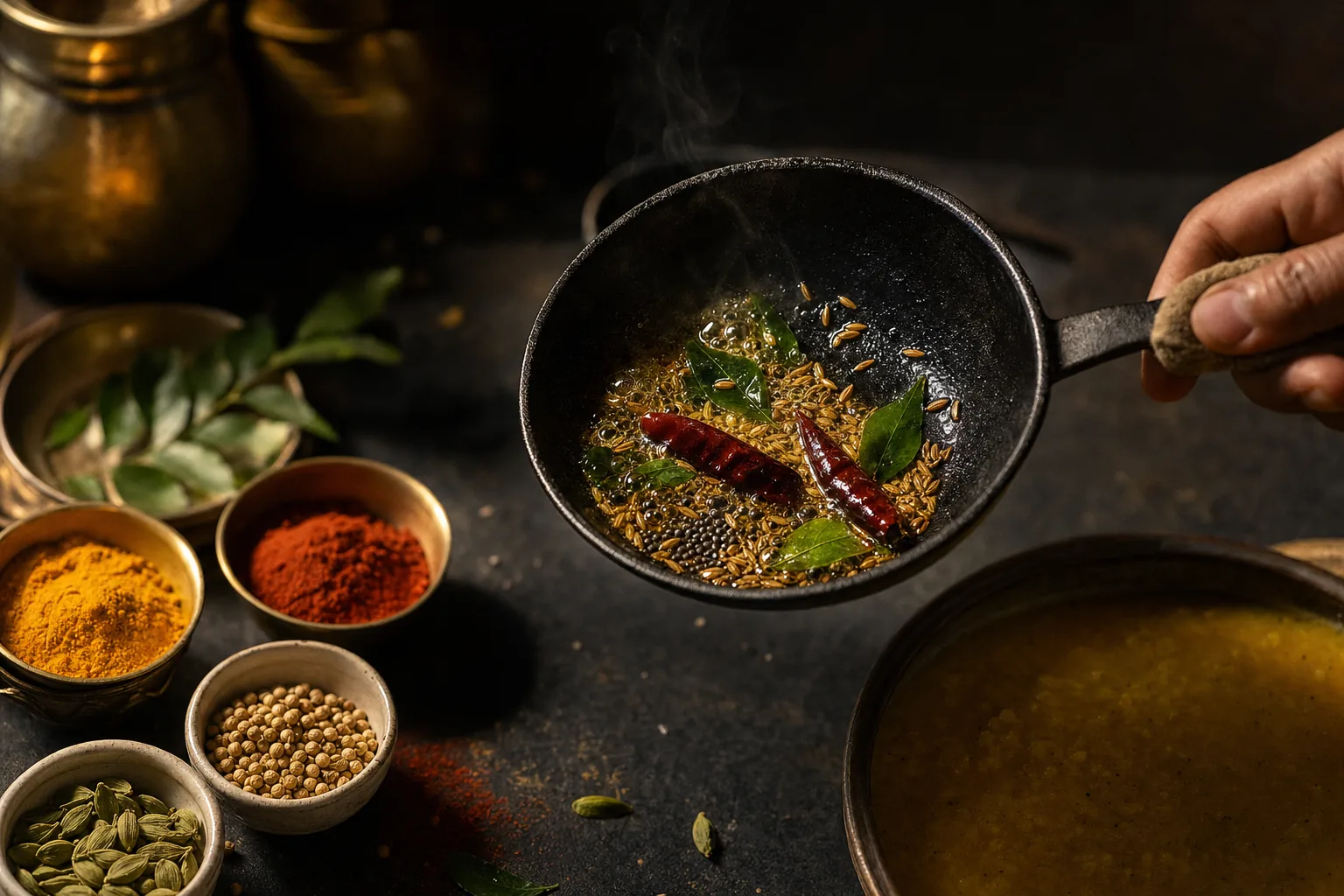
Why spice technique matters more than the spice list
Two cooks can follow the same dal recipe with identical spices and produce completely different results. The difference is almost always technique: when each spice meets heat, what fat it meets, and how long it stays there. Spices carry their flavor in volatile oils and pigments, many of which dissolve far better in fat than in water. A teaspoon of cumin stirred into simmering lentils tastes dusty; the same cumin sizzled in ghee and poured over the top tastes nutty, warm and unmistakably finished.
Heat also changes spices chemically. Toasting drives off moisture, deepens color and creates new roasted aromas, while too much heat creates bitterness that no amount of salt or cream can hide. Indian cooking has a precise vocabulary for this: bhunao for frying a masala until the oil separates, tadka or chhonk for tempering spices in hot fat, and dum for slow, sealed cooking that lets aromatics infuse gently.
For a professional kitchen the lesson is practical. Write spice timing into your recipes as clearly as you write weights, train cooks to use sound and smell as cues, and taste the tempering fat itself during training so everyone learns what correctly bloomed spices should taste like. A cook who can hear the change in a sizzle, or smell the moment cumin turns from raw to toasted, will produce consistent food on a busy night without a timer.
Whole spices versus ground spices
Whole and ground forms of the same spice behave like different ingredients. Whole seeds and pods release flavor slowly, survive longer in hot fat and keep their character through long braises. Ground spices offer more surface area, so they release flavor almost instantly and also scorch almost instantly. Most Indian dishes use both, layered at different stages. Understanding which form a recipe calls for, and why, prevents most burnt-spice mistakes.
Whole spices: structure and slow release
Cumin seed, mustard seed, fennel, fenugreek, cloves, green and black cardamom, cinnamon or cassia bark, bay leaf and dried red chilies are the usual whole spices. They go into fat at the start of a dish or into a finishing tadka. Cracking cardamom pods or bruising cloves lightly speeds their release. In biryani and pulao, whole spices perfume the rice during cooking, and you should warn guests on the menu or remove the hardest pieces before plating if your service style demands it.
Ground spices: color, body and quick flavor
Turmeric, coriander powder, chili powder, ground cumin and garam masala are typically ground. Add them after onions, ginger and garlic have cooked down and released moisture, which protects the powders from direct contact with very hot oil. Many cooks add a spoonful of water with the powders and fry until the water evaporates and the oil glistens at the edges. That moment, when the fat separates from the masala, signals that the raw taste is gone.
| Spice | Usual form | When to add | Watch for |
|---|---|---|---|
| Cumin | Whole and ground | Seeds first in hot fat; powder with other ground spices | Seeds turn from tan to deep brown in seconds |
| Black mustard seed | Whole | First, in hot oil, before curry leaves | Wait for the popping to slow before adding the next item |
| Turmeric | Ground | With the masala, after onions soften | Burns and turns bitter in dry, very hot oil |
| Asafoetida (hing) | Ground compound | A pinch, for a few seconds, just before other ingredients | Many commercial blends contain wheat flour |
| Garam masala | Ground blend | Near the end of cooking or as a finish | Long cooking dulls its top notes |
How to temper spices: the tadka technique step by step
Tadka is both a technique and a finishing element. It can begin a dish, when spices are bloomed in the pot before onions and tomatoes go in, or finish it, when a small pan of sizzling spiced fat is poured over dal, raita, kadhi or chutney just before serving. The finishing version is dramatic at the pass and delivers the most vivid aroma to the guest because nothing has had time to fade.
Use a small, heavy pan with a long handle so heat is even and the cook can swirl and pour safely. Ghee gives a rich, nutty result with a high smoke point; neutral oils such as sunflower or groundnut give a cleaner taste; mustard oil and coconut oil each define a regional style. Measure fat generously enough to cover the base of the pan, roughly one to two tablespoons per portion of dal.
Most mistakes come from rushing or overcrowding. If the fat is not hot enough, seeds soak up oil and taste greasy; if it is too hot, the first seeds burn before the last ones are added. Order matters because each ingredient needs a different amount of time. Prepare every ingredient in small bowls before the fat goes on, in the order they will be added, because there is no time to measure once the seeds start popping.
- Heat the fat over medium-high heat until it shimmers; a single cumin or mustard seed dropped in should sizzle immediately.
- Add mustard seeds first if using them and partially cover the pan until the popping slows.
- Add cumin seeds, then dried red chilies, and swirl until the cumin darkens a shade and smells toasted, usually ten to twenty seconds.
- Add asafoetida for just a few seconds, followed by curry leaves, garlic slivers or ginger, standing back as the leaves spatter.
- Take the pan off the heat and add chili powder or Kashmiri chili last so the residual heat blooms it without burning.
- Pour immediately over the dish, ideally at the pass, and serve before the aroma fades.
Regional tempering styles across India
Calling a dish Indian tells a guest very little; the tempering often tells you where it comes from. Each region has a characteristic fat, a set of seeds and a sequence. A South Indian sambar and a Punjabi dal tadka are both lentils finished with spiced fat, yet they taste of different places entirely. When you build a regional dish, research and follow its own tempering rather than defaulting to a generic cumin-and-chili mix.
These patterns are starting points, not rules, and home cooks in every state vary them. Use them to make deliberate choices and to train cooks to recognize what makes each style distinct. Encourage cooks to taste regional dishes side by side during training. Hearing a mustard-oil chhonk crackle, or smelling curry leaves hit coconut oil, teaches more than any written description and helps the team cook each style with confidence and respect for its origins.
- North Indian and Punjabi: ghee or neutral oil with cumin seed, dried red chili, garlic, sometimes onion and tomato; finished with Kashmiri chili for color.
- Tamil Nadu and Karnataka: oil with mustard seed, urad dal and chana dal fried golden, dried red chili, asafoetida and curry leaves.
- Kerala: coconut oil with mustard seed, shallots, dried chili and plenty of curry leaves, often poured over coconut-based curries.
- Bengal: mustard oil heated until it mellows, with panch phoron (fenugreek, nigella, cumin, black mustard and fennel seed) and dried chili.
- Gujarat: oil or ghee with mustard, cumin, asafoetida, sometimes cloves and cinnamon, balanced with a touch of jaggery and lemon.
- Maharashtra: oil with mustard, cumin, asafoetida, turmeric and curry leaves, with goda masala supplying the deeper warm notes.
Garam masala and regional spice blends
Garam masala means warm spice mix, and there is no single correct recipe. Northern versions lean on cardamom, cinnamon, cloves, black pepper and cumin; Mughlai blends add mace, nutmeg and rose petals; Kashmiri households often use fennel and dried ginger. Treat your house garam masala as a signature recipe, write it down by weight, and use it consistently so dishes taste the same from week to week.
Whole spices toasted and ground in-house taste noticeably brighter than pre-ground products. The trade-off is labor and consistency, so many kitchens toast and grind weekly in a fixed batch size and buy single ground spices such as turmeric and chili powder from a trusted supplier. Whatever you choose, record the supplier and batch so you can trace a change in flavor back to its source.
Blends worth making in-house
Beyond garam masala, sambar powder, rasam powder, chaat masala, goda masala and panch phoron each define a family of dishes. Sambar powder typically combines coriander seed, chana dal, dried red chili, fenugreek, cumin and curry leaves, roasted separately because each ingredient browns at a different rate. Chaat masala relies on amchur and black salt for its sour, sulfurous lift and is never cooked. Panch phoron stays whole and goes straight into hot mustard oil.
Toasting and grinding without bitterness
Dry-roast each spice separately in a heavy pan over medium heat, stirring constantly, and pull it as soon as it smells fragrant and darkens slightly. Spread the spices on a tray to cool completely before grinding, because warm spices clump and grind unevenly. Use a dedicated grinder that is never used for coffee, sift if you want a fine texture, and grind only what you will use within a few weeks.
Storage, freshness and buying
Spices rarely become unsafe, but they lose aroma steadily, and a stale spice forces cooks to use more of it for less flavor. Heat, light, air and moisture are the enemies. The worst place in a kitchen to keep spices is the shelf above the range, which is exactly where many cooks put them for convenience. Move the line supply somewhere cooler and keep only what one service needs within reach.
As a working guide, whole spices keep good flavor for about a year when sealed and stored cool and dark, and ground spices for a few months. Test by rubbing a pinch between your fingers; if the aroma is faint, it is time to replace it. Build a quarterly check into your cleaning schedule, when someone smells each container and discards or uses up anything tired.
- Store spices in airtight, opaque or tinted containers in a cool, dry store room, not over the stove.
- Label every container with the spice name, supplier and the date it was opened or ground.
- Keep a small, refillable line container at the station and the bulk supply in storage, so the main stock is not exposed to heat every service.
- Buy in quantities you will use within a few months, even if larger bags are cheaper per kilo.
- Use a clean, dry spoon every time; moisture introduced into a jar of ground spice leads to clumping and mold.
- Note allergens: some asafoetida compounds contain wheat, and mustard is a regulated allergen in several regions.
Balancing heat without flattening flavor
Chili heat comes mostly from capsaicin, which is fat-soluble. That is why a yogurt raita, a dollop of cream or a spoon of ghee softens heat far better than water. Acid, sugar and salt change how heat is perceived as well, which is why many dishes balance chili with tamarind, jaggery, tomato or lime. Use these tools to shape heat rather than simply reducing the chili.
Choose chilies for their character, not only their strength. Kashmiri and Byadgi chilies give deep red color with mild to moderate heat. Guntur chilies are noticeably hotter. Fresh green chilies add sharp, grassy heat, and small bird’s eye chilies are fierce. Blending a mild coloring chili with a smaller amount of a hot one lets you hit a target color and heat level independently.
Heat also builds over time. A sauce tasted straight from the pot is less hot than the same sauce after resting, and a guest eating a full portion experiences more heat than a cook tasting a spoonful. Taste a realistic portion during recipe development and adjust before the dish reaches the menu. Cold preparations such as chutneys and pickles also change as they sit, so taste them again after resting.
Use dairy, acid and sweetness to shape heat rather than simply reducing the chili.
Frequently asked questions
What is the difference between tadka and tempering?
They are the same technique. Tadka, also called chhonk, vaghar or oggarane depending on the region, is the Indian name for tempering: blooming whole spices, aromatics and sometimes ground spices in hot fat to release their flavor. The spiced fat either starts a dish or is poured over a finished dish such as dal, raita or chutney just before serving.
Should I add ground spices directly to hot oil?
Only briefly and carefully. Ground spices burn within seconds in very hot, dry oil. Add them after onions, ginger and garlic have softened so there is moisture in the pan, or add a splash of water with the powders. For a finishing tadka, take the pan off the heat before adding chili powder so residual heat blooms it without scorching.
How long do whole and ground spices stay fresh?
Stored airtight in a cool, dark place, whole spices usually keep good flavor for about a year and ground spices for a few months. They seldom become unsafe, but aroma fades steadily. Rub a pinch between your fingers; if the smell is weak, replace it. Date containers when opened or ground so the kitchen can rotate stock.
Which oil is best for tempering Indian spices?
It depends on the regional style. Ghee gives a rich, nutty finish and handles high heat well. Mustard oil defines Bengali and some North Indian food, coconut oil is typical in Kerala, and neutral oils such as sunflower or groundnut give a clean taste. Choose the fat that matches the dish rather than one oil for everything.
How should a restaurant describe spice levels on its menu?
Use a small, consistent scale such as mild, medium and hot, apply it the same way across every dish, and name the source of heat in the description. Train servers by tasting sample dishes at each level. Only offer to make a dish milder when the kitchen can genuinely adjust that recipe during service.
- #indianspices
- #tadka
- #tempering
- #garammasala
- #spicelevels