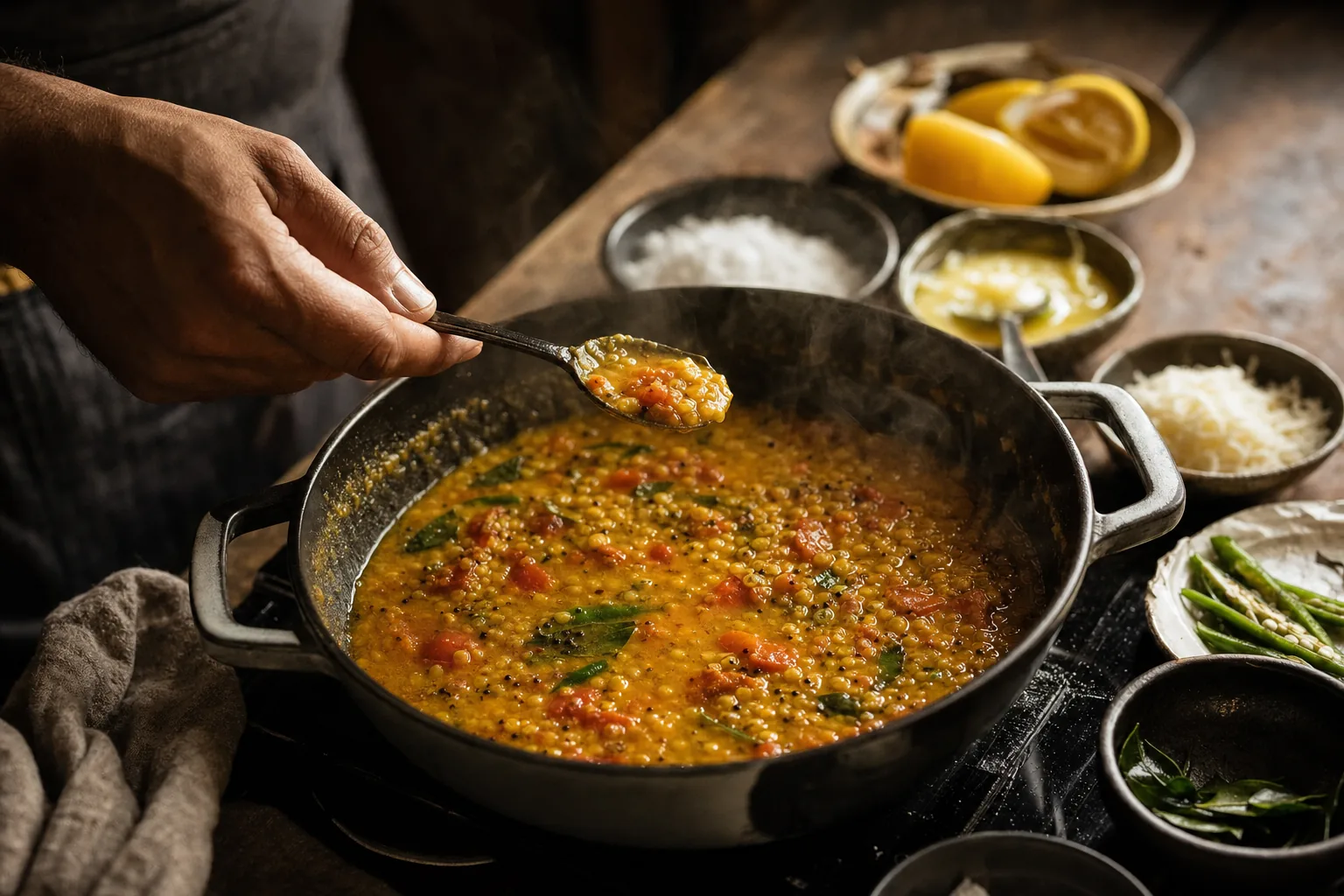
What a balanced dish actually is
A balanced dish tastes complete. Nothing sticks out as too salty, too sharp or too greasy, and nothing seems to be missing. When guests describe food as flat, heavy or one-note, they are usually tasting an imbalance between a handful of elements: salt, fat, acid, heat, sweetness, bitterness and umami. Great cooks are not adding secret ingredients; they are tasting constantly and adjusting these levers.
Balance is not the same as moderation. A vindaloo is fiercely hot and sour, a Thai larb is bright with lime and chili, and a French beurre blanc is rich with butter. Each is balanced within its own style because its strong elements are supported by others: the acid in vindaloo cuts its richness, the herbs and fish sauce in larb give depth behind the heat, and the wine reduction keeps the butter sauce from tasting heavy.
This article treats each element as a tool, explains how it interacts with the others and ends with a practical system for tasting and correcting dishes during service. The goal is a shared language in the kitchen, so that when a chef says a sauce needs lifting or a curry feels heavy, every cook knows which lever to reach for and roughly how much to use.
Salt: the seasoning that unlocks everything else
Salt does more than make food taste salty. In the right amount it suppresses bitterness, rounds out sweetness and makes aromas seem stronger. Under-salted food tastes dull even when the ingredients are excellent. Different salts vary widely in density: a spoon of fine table salt can weigh nearly twice as much as a spoon of coarse kosher-style flakes. That is why professional recipes should list salt by weight, not by volume.
Season in layers. Salt meat ahead of cooking, often hours or a day ahead for large cuts, so it penetrates and helps the protein hold moisture. Salt cooking water for pasta and vegetables so they are seasoned from inside. Season sauces and braises gradually as they reduce, and finish with a little flaky salt where crunch and a bright hit of salinity help, such as on grilled meat, chocolate desserts or sliced tomatoes.
- Use one or two standard salts across the kitchen so the team’s sense of seasoning stays calibrated.
- Dry-brine whole chickens and thick steaks with roughly 1 percent of their weight in salt, refrigerated uncovered.
- Salt blanching water generously; vegetables absorb only a little, but enough to taste seasoned.
- Remember that stocks, soy sauce, cheese, olives and cured meats add salt; season after they go in.
- Taste reduced sauces again before service, because reduction concentrates salt.
- Keep finishing salt in a covered container at the pass so it stays dry and clean.
Fat: the carrier of flavor and texture
Fat carries flavor, especially fat-soluble aromas from spices, herbs and alliums. It also shapes texture, giving richness, coating the palate and softening sharp edges. A vinaigrette without enough oil is harsh; a dal without a finishing tadka of ghee and spices tastes thin even if it is well salted. The choice of fat is a flavor decision in its own right: butter, ghee, olive oil, mustard oil, sesame oil and coconut oil each point a dish in a different direction.
Indian tempering shows how fat transfers flavor. Whole cumin, mustard seeds, curry leaves, dried chilies and asafoetida are bloomed in hot oil or ghee for seconds, releasing compounds that would stay locked in the spices otherwise. Poured over a dal or raita, that fat spreads flavor through the whole dish. European cooks use the same principle when they finish a sauce with cold butter or drizzle peppery olive oil over a soup.
Too much fat makes food heavy and dulls other flavors. If a dish feels greasy, it usually needs acid or salt to cut through, a crunchy or fresh element for contrast, or simply skimming. Rendered fat on braises should be lifted off before service. Chilling a braise overnight makes this easy, because the fat sets into a solid layer that lifts away cleanly and can often be saved for roasting potatoes.
Acid: the element most dishes are missing
When a dish tastes correctly salted but still seems flat, the answer is often acid. A squeeze of lemon, a splash of vinegar or a spoon of yogurt brightens other flavors and makes rich food feel lighter. Acid also balances sweetness and helps cut through fat, which is why pickles go with fried food, lime with coconut curries and a sharp vinaigrette with a rich terrine.
Every cuisine has its acid toolkit. European kitchens use wine, citrus and many vinegars. Indian cooks reach for tamarind, kokum, raw mango, amchur, lime and yogurt. Southeast Asian kitchens rely on lime, tamarind and rice vinegar. Japanese cooking uses rice vinegar and yuzu. Learn the character of each: tamarind is fruity and deep, kokum is sour with a gentle astringency, sherry vinegar is nutty, and lemon is bright and clean.
Timing changes the effect. Acid added early mellows and blends; acid added at the end gives a fresh, sharp lift. Many chefs keep a little acid back for the final seasoning, tasting as they go. Add it a few drops at a time, since too much acid is harder to correct than too little. Keep lemon wedges and a bottle of a neutral vinegar at every hot station so cooks can adjust without leaving the line.
Heat: temperature and chili
Heat has two meanings in the kitchen, and both affect balance. Serving temperature changes how we perceive taste. Cold dulls sweetness and salt, which is why ice cream base tastes overly sweet when warm and why chilled soups and terrines need more seasoning than hot dishes. Hot food releases more aroma. Season food at, or as close as possible to, the temperature at which it will be eaten.
Chili heat comes mainly from capsaicin, which triggers a burning sensation rather than a taste. Different chilies bring different qualities: Kashmiri chili gives color with mild heat, Guntur and bird’s eye chilies are sharply hot, chipotle is smoky, and Sichuan peppercorn adds a tingling numbness rather than heat. Layer them for complexity: dried chili in the base, fresh chili for brightness and chili oil to finish.
Capsaicin dissolves in fat and is softened by dairy, sugar and starch, which is why raita, coconut milk, rice and bread temper spicy food. When heat overwhelms a dish, it needs more of the base ingredients, more fat or dairy, or a touch of sweetness rather than water. Be clear with guests about spice levels on the menu so expectations match the plate.
Sweetness, bitterness and umami
Beyond the big four, three more tastes are essential balancing tools. Each can rescue a dish when used carefully and ruin it when overdone. Think of them as the supporting cast that makes the main flavors convincing. Most great dishes contain a little of all three, even when none of them is obvious: a touch of caramelized sweetness, a hint of char or zest and a savory backbone from stock, cheese or fermented seasoning.
These tastes also interact. Salt softens bitterness, sweetness tames acidity and chili heat, and umami makes a dish feel seasoned with less salt. When a cook understands those relationships, correcting a sauce becomes a matter of choosing the right lever instead of adding more of whatever is nearest. The notes below describe each one and where it comes from in different cuisines.
Sweetness
Sweetness rounds out acidity and heat. It does not have to come from sugar: caramelized onions, roasted vegetables, reduced balsamic, jaggery, honey, dates and ripe fruit all contribute. A small amount of jaggery in a Gujarati dal or a sambar balances tamarind and chili. In tomato sauces, a long reduction brings out natural sweetness. Taste carefully, because a little sweetness reads as balance and slightly more reads as dessert.
Bitterness
Bitterness adds sophistication and cuts richness. Radicchio, endive, dark chocolate, coffee, charred edges, citrus zest, fenugreek leaves and bitter gourd all bring it. Bitter elements are best balanced with salt, which suppresses bitterness, and with fat and sweetness. A bitter leaf salad with a salty cheese, a sweet dressing and crunchy nuts is a lesson in balance on one plate.
Umami
Umami is the savory depth associated with glutamates and certain nucleotides. Parmesan, aged cheeses, soy sauce, miso, fish sauce, anchovies, dried shrimp, mushrooms, ripe tomatoes, seaweed and long-cooked stocks are rich in it. Umami makes food taste fuller and can reduce the amount of salt a dish needs. A spoon of miso in a butter sauce or a little fish sauce in a tomato braise adds depth guests notice without being able to name.
| Element | Common sources | What it does | Too much tastes |
|---|---|---|---|
| Salt | Sea salt, soy, cheese, cured meats | Amplifies flavor, suppresses bitterness | Harsh, drying |
| Acid | Citrus, vinegar, tamarind, yogurt | Brightens, cuts fat and sweetness | Sharp, sour |
| Fat | Butter, ghee, oils, cream, coconut | Carries aroma, adds richness | Greasy, heavy |
| Sweet | Jaggery, honey, caramelized onion | Rounds acidity and heat | Cloying |
| Bitter | Chicory, coffee, char, fenugreek | Adds complexity, cuts richness | Astringent, unpleasant |
| Umami | Miso, parmesan, mushrooms, stock | Deepens savoriness | Murky, overly savory |
How to fix a dish that tastes wrong
When a dish is off, identify the problem before reaching for an ingredient. Taste it, then describe it in one word: flat, salty, sour, sweet, bitter, hot or greasy. Each description points to a small set of corrections. Make one adjustment at a time, taste again and stop as soon as the dish tastes complete. Adding three corrections at once makes it impossible to know which one worked, and it often swaps one imbalance for another.
A popular myth says a raw potato will pull salt out of an over-salted soup. It absorbs some salty liquid, but it does not selectively remove salt. The reliable fixes are to add more unsalted base, dilute with unsalted stock or water and adjust consistency, or mask with fat and acid. For the future, the real fix is a recipe with a measured salt weight.
- Flat or dull: add salt first, then a little acid, then consider umami such as a splash of soy or a spoon of parmesan.
- Too salty: add more unsalted base, stock or vegetables; a little acid, fat or sweetness can mask what remains.
- Too sour: add fat, a touch of sweetness or more of the base; a pinch of salt can soften sharp acidity.
- Too sweet: add acid and salt; bitterness or chili heat can also cut through sweetness.
- Too bitter: add salt first, then fat or sweetness; remove burnt pieces rather than trying to cover them.
- Too hot from chili: add more base, dairy or coconut, fat, a little sugar or a starchy accompaniment.
- Too greasy: skim the fat, add acid and salt, and serve with something fresh or crunchy.
Tasting protocols on the line
In many kitchens, tasting is left to instinct, which means each cook seasons differently and the dish changes with the shift. A tasting protocol turns seasoning into a repeatable process. It defines when to taste, who tastes, how to taste hygienically and what standard to compare against. It takes a few minutes per service and pays for itself the first time it catches an over-reduced sauce before it reaches a guest.
Hygiene comes first. Use a clean disposable or metal tasting spoon every time, never the stirring spoon, and never double-dip. Keep a container of clean spoons and a container for used ones at every station. Follow your local food authority’s guidance on tasting practices, especially in open kitchens where guests can see the line. Wash hands after handling used spoons, and make sure the used-spoon container is emptied and sent to the dish area regularly during service.
Calibration is the second part. Senior chefs should taste every sauce and component before service, ideally alongside the cook who made it, and explain what they are tasting for. Over time, the team’s palates converge. Palate fatigue is real: taste with a sip of water or a plain cracker between components, and do not rely on one person tasting dozens of sauces in a row.
- Taste every component at the start of service during line check, at the serving temperature.
- Taste again after reductions, after holding for an hour and after any new batch replaces an old one.
- Plate one full dish before service opens and taste it as a guest would, with every component together.
- Note adjustments in the recipe book so the next batch starts closer to the target.
- Train new cooks by tasting their components with them and explaining the correction, not just making it.
A tasting protocol turns seasoning into a repeatable process.
Frequently asked questions
What does salt, fat, acid, heat mean in cooking?
It is a way of describing four elements that shape how food tastes. Salt amplifies flavor, fat carries aroma and adds richness, acid brightens and cuts heaviness, and heat covers both cooking temperature and chili. Balancing these, along with sweetness, bitterness and umami, is the core skill behind seasoning any dish in any cuisine.
How do you fix food that is too salty?
Add more unsalted base, such as extra vegetables, beans, rice, unsalted stock or water, then adjust the consistency and other seasoning. A little acid, fat or sweetness can help mask remaining saltiness. Adding a raw potato does not selectively remove salt. To prevent the problem, list salt by weight in recipes and taste after reductions.
What can I add if my dish tastes bland?
Start with salt, added a pinch at a time and tasted between additions. If it still seems flat, add a little acid such as lemon juice, vinegar or tamarind. If it needs depth, try umami from soy sauce, miso, parmesan or a good stock. Fresh herbs and a finishing fat can also lift aroma.
How do you reduce spiciness in a curry?
Add more of the base ingredients, such as tomatoes, onions or lentils, or enrich it with yogurt, cream, coconut milk or ghee, because capsaicin dissolves in fat and is softened by dairy. A small amount of jaggery or sugar also helps. Serving with rice, bread or raita tempers the heat on the plate.
Why should chefs taste food at serving temperature?
Temperature changes how we perceive taste. Cold food tastes less sweet and less salty, and it releases fewer aromas, so a chilled soup seasoned while hot can taste bland once cold. Seasoning close to serving temperature ensures the guest experiences the balance the cook intended.
- #flavorbalance
- #seasoning
- #saltfatacidheat
- #umami
- #tasting