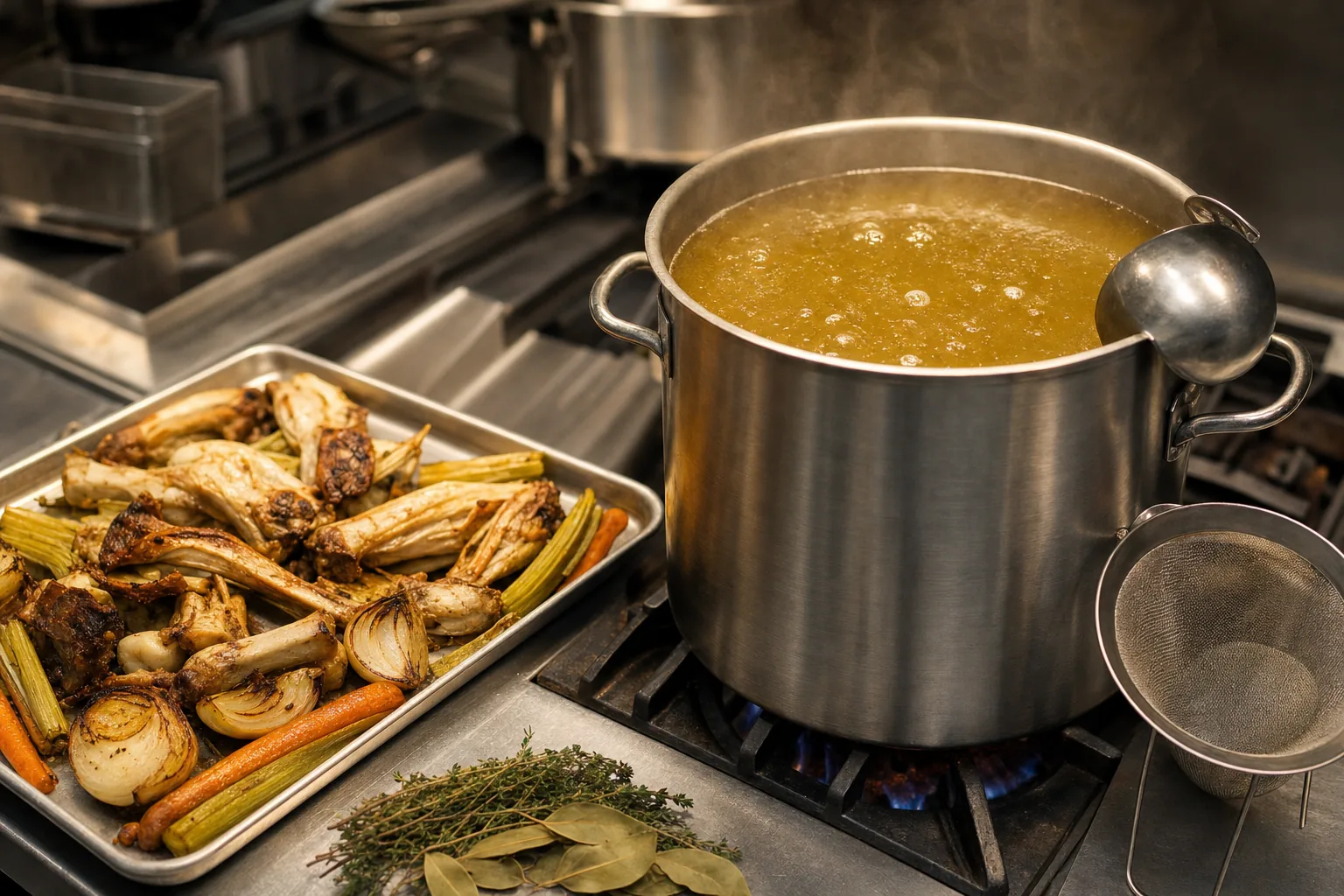
Stock, broth and bone broth: what is the difference?
The words are used loosely, but in a professional kitchen they mean different things. A stock is an unseasoned liquid made mostly from bones, aromatics and water. Its job is body and depth, provided largely by gelatin extracted from connective tissue. Because it is unsalted, a stock can be reduced into a sauce without becoming too salty. A broth is made with meat as well as or instead of bones, is usually seasoned, and is meant to be served on its own or as the base of a soup.
Bone broth is a long-simmered stock, often cooked for twelve hours or more, served seasoned as a drink or soup. Dashi, the Japanese base, uses kombu and dried fish or mushrooms and is ready in under an hour. Indian kitchens have yakhni, a fragrant meat stock with whole spices that underpins pulao and some kormas. Knowing which one you are making clarifies the method, the cooking time and how you will use it.
For most restaurants the real question is not which definition is correct but which liquids the menu actually needs. A kitchen serving classical sauces needs a dependable brown stock; a ramen bar lives on its broths and tare; an Indian kitchen may rely on a yakhni for its pulao and a vegetable stock for its soups. Start from the dishes, list the bases they require, and make only those. Every extra stock costs space, labor and cooling capacity.
Core stock ratios and simmering times
Ratios keep stock consistent from cook to cook. A widely used starting point is roughly two liters of cold water per kilo of bones, with mirepoix of onion, carrot and celery at about ten percent of the bone weight. Add a sachet of parsley stems, thyme, bay leaf and peppercorns towards the end of cooking so the herbs do not turn bitter. Adjust the water to just cover the bones in your pot; too much water gives a thin stock that needs costly reducing.
The table below gives working guidelines, not laws. Taste regularly, note what your bones and pots actually produce, and write your own figures into the house recipe. Record the weight of bones, the volume of water and the final yield for each batch during the first few weeks. Those numbers show whether your pot, burner and bones match the guideline, and they let a new cook reproduce the house stock on the first attempt.
| Stock | Main ingredients per liter of water | Simmering time | Notes |
|---|---|---|---|
| White chicken | About 500 g raw bones, 50 g mirepoix | 3 to 4 hours | Blanch bones first for clarity |
| Brown veal or beef | About 500 g roasted bones, 50 g mirepoix, tomato paste | 6 to 8 hours | Roast bones and caramelize paste first |
| Fish fumet | About 500 g white fish bones, sweated aromatics, white wine | 30 to 45 minutes | Longer cooking turns it bitter and chalky |
| Vegetable | About 400 g mixed vegetables and trim | 45 to 60 minutes | Avoid strong brassicas and starchy potato |
| Dashi | About 10 g kombu, 10 to 20 g katsuobushi | About 1 hour including steeping | Remove kombu before the water boils |
White and brown stocks
White and brown stocks share a method but differ in how the bones are treated before they meet the water. That single step changes color, aroma and how the stock behaves in sauces. Most kitchens that make classical sauces keep both: white stock for velouté, poaching and pale soups, brown stock for demi-glace, braises and jus. Both demand the same patience at the stove.
White stock: clarity and a clean taste
For a white chicken or veal stock, rinse the bones, cover them with cold water, bring to a boil, then drain and rinse again. This blanching removes much of the blood and surface protein that would otherwise cloud the stock. Return the bones to a clean pot with fresh cold water, bring slowly to a simmer, and add the mirepoix after the first round of skimming. Use white vegetables such as leek, onion and celery if you want a very pale result.
Brown stock: roasting for depth
Roast veal or beef bones in a hot oven, around 200 to 220 degrees Celsius, until deep brown but not black, turning them once. Add the mirepoix to the tray for the last part of roasting, then smear tomato paste over the bones and roast a few minutes more until it darkens to a rusty color. Transfer everything to the pot, deglaze the roasting tray with water and scrape every browned bit into the stock. Pour off excess fat first, or the stock will taste greasy.
Fish fumet, vegetable stock and dashi
Fast stocks reward precision more than patience. Fish fumet uses the bones and heads of lean white fish such as sole, turbot or cod, with gills removed and the bones rinsed of blood. Sweat sliced onion, leek, fennel and mushroom trim in butter without coloring, add the bones and sweat briefly, then add white wine and cold water. Simmer gently for thirty to forty-five minutes and strain. Oily fish such as mackerel or salmon give a strong, fatty stock that suits few classical dishes.
Vegetable stock is often an afterthought, yet for many guests it is the only stock they can eat. Build it deliberately with onion, leek, carrot, celery, fennel, tomato and mushroom, roasting some of them for a darker version. Leave out cabbage, broccoli and other brassicas, which turn sulfurous, and starchy vegetables, which cloud it. Taste it on its own; a good vegetable stock should be pleasant to sip.
For dashi, soak kombu in cold water for at least thirty minutes, then heat slowly and remove it just before the water boils, around sixty to seventy degrees for a gentle extraction. Bring to a boil, add katsuobushi, turn off the heat and steep for a few minutes before straining without pressing. Shiitake and kombu make a vegetarian dashi. Never squeeze the flakes, which clouds the broth.
Simmering and skimming like a professional
Starting in cold water lets proteins dissolve and then coagulate slowly as the temperature rises, carrying impurities to the surface where you can skim them off. A rolling boil does the opposite: it churns fat and fine particles back into the liquid and emulsifies them, giving a cloudy, greasy stock. Aim for a bare simmer, with only an occasional bubble breaking the surface, which in practice is a little below boiling.
Do not salt a stock. It will be reduced, combined and seasoned later, and early salt makes reduction unpredictable. Do not stir it either, as stirring breaks up the bones and vegetables and clouds the liquid. Resist the temptation to add leftovers or scraps halfway through. Every addition changes the timing and clarity, and the stock should be a controlled recipe, not a catch-all. Keep the lid off so you can see the surface and judge the simmer at a glance.
- Place blanched or roasted bones in a tall, narrow pot and cover with cold water by a few centimeters.
- Bring slowly to a simmer over moderate heat, skimming the gray foam as it rises.
- Add mirepoix after the first heavy skimming and the herb sachet towards the last hour.
- Hold at a bare simmer, skimming fat and foam every twenty to thirty minutes, and top up with cold water if bones become exposed.
- Strain through a fine chinois, or a sieve lined with cloth, without pressing the solids.
- Cool immediately using a fast cooling method, then remove the solidified fat once chilled.
Cooling stock safely
A large pot of stock is one of the riskiest items in any kitchen. It holds heat for hours, and spore-forming bacteria that survive cooking can multiply rapidly as it passes slowly through the temperature danger zone. Putting a full, covered stockpot straight into the walk-in does not cool it quickly enough and warms everything stored around it. Fast, active cooling is the only safe approach.
Widely used guidance, such as the United States Food Code, calls for cooling cooked food from 60 to 21 degrees Celsius within two hours and from 21 to 5 degrees within a further four hours. Rules vary by country, so follow your local food authority and record cooling times on a log sheet. A cooling log also shows where your equipment falls short.
- Divide stock into shallow containers, no deeper than about five to eight centimeters, before chilling.
- Stand the pot or containers in an ice-water bath in a sink and stir regularly.
- Use frozen ice wands or paddles in larger batches, and keep spares in the freezer.
- Leave containers uncovered or loosely covered until cold, then cover, label and date.
- Check and record temperatures with a calibrated probe thermometer at set intervals.
- Reheat stock to a rolling boil before use and never mix old stock into a new batch.
Storage, yield and cost
Chilled stock is commonly kept for three to four days, and frozen stock for a few months with good quality, though your local food authority sets the limits you must follow. Store it in labeled, dated containers of a size that matches how the kitchen uses it, such as one-liter tubs for sauces and larger ones for soup. Freezing stock in measured portions saves defrosting more than you need.
Expect to recover noticeably less liquid than the water you added, often a little over half after a long simmer, skimming and straining. Weigh what goes in and measure what comes out for a few batches, then use those figures to cost a liter of stock in your recipe costing. Many kitchens are surprised by the true cost once bones, vegetables, energy and labor are counted.
When space is tight, reduce strained stock by three-quarters or more into a glace that sets firm when chilled. A spoon of glace can enrich a pan sauce, and it occupies a fraction of the storage. Glace keeps well chilled or frozen, and it can be reconstituted with water when a recipe needs ordinary stock. Treat it with the same labeling and dating discipline as the stock itself, and note the reduction ratio so cooks know how much water to add back.
Frequently asked questions
Why is my stock cloudy?
Cloudiness usually comes from boiling instead of simmering, which emulsifies fat and fine particles into the liquid. Stirring, skipping skimming, pressing the solids when straining and not blanching bones for a white stock also cloud it. Start in cold water, hold a bare simmer, skim regularly and strain gently through a fine sieve or cloth.
How long should I simmer chicken, beef and fish stock?
As a guide, simmer white chicken stock for about three to four hours, brown veal or beef stock for six to eight hours, and fish fumet for only thirty to forty-five minutes. Fish bones turn bitter with long cooking. Vegetable stock needs about an hour. Taste as you go and record what works for your bones and equipment.
What is the safest way to cool a large batch of stock?
Strain it, divide it into shallow containers, and chill it in an ice-water bath or with ice wands, stirring often, before moving it to the refrigerator. Many food codes require cooling from 60 to 21 degrees Celsius within two hours and to 5 degrees within four more. Check your local rules and log temperatures.
Is bone broth the same as stock?
Bone broth is essentially a stock that is simmered much longer, often twelve to twenty-four hours, and then seasoned to drink or serve as a soup. Classic stock is unseasoned and cooked for a shorter, defined time so it can be reduced into sauces. The techniques of skimming, straining and cooling are the same for both.
Can I make dashi without fish?
Yes. Soak kombu and dried shiitake mushrooms in cold water, ideally for several hours or overnight in the refrigerator, then heat gently and strain. The result is a savory, vegetarian dashi suitable for miso soup, noodle broths and simmered vegetables. Label it clearly, because guests may assume dashi always contains fish.
Should I add salt to stock?
No. Professional stocks are left unsalted because they are reduced, combined and used in many dishes. Salt concentrates as liquid evaporates, so a stock that tastes right at the start can make a reduced sauce far too salty. Season the finished soup, sauce or braise instead. Broths served on their own are the exception and are seasoned at the end.
- #stocks
- #bonebroth
- #dashi
- #foodsafety
- #kitchenfundamentals