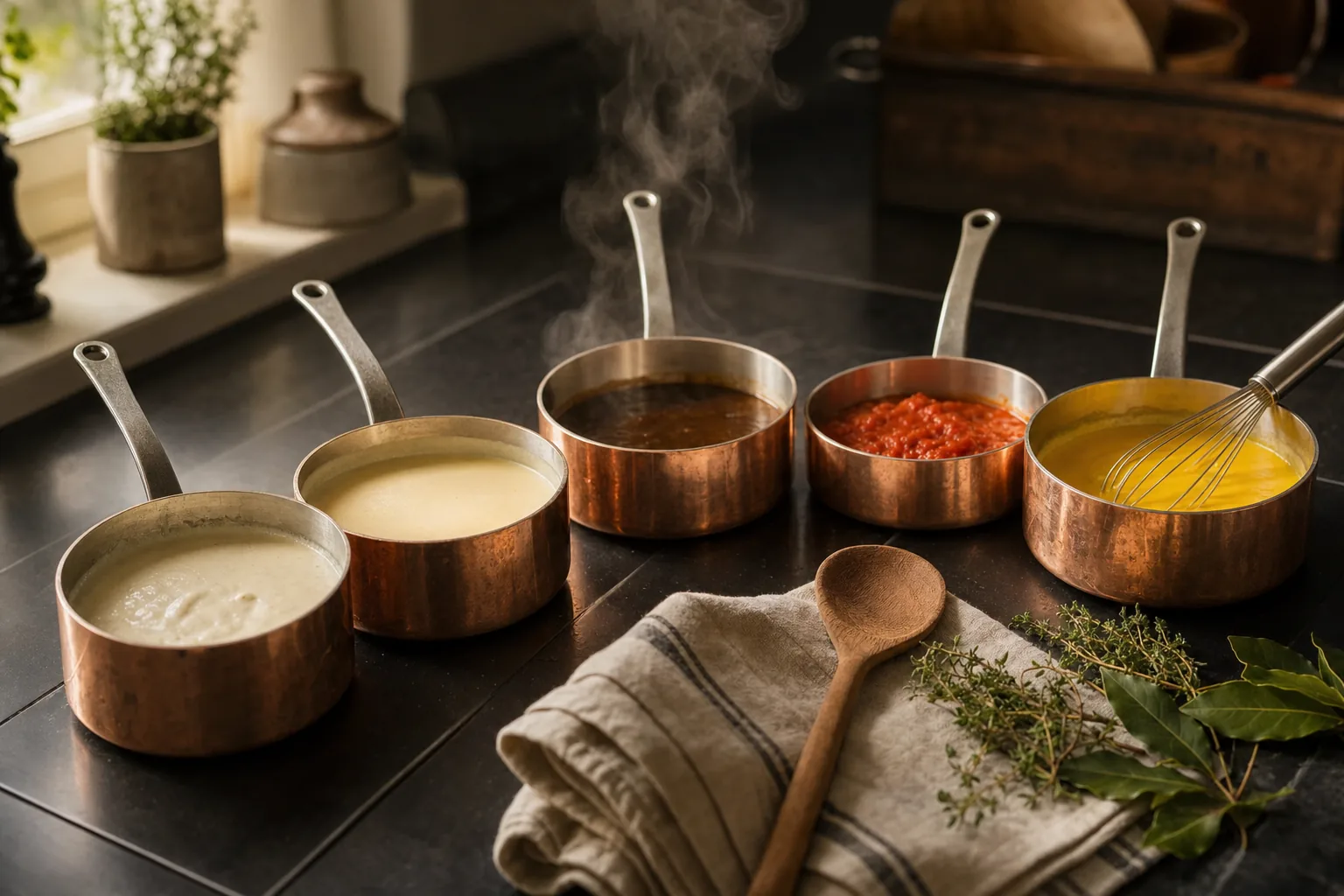
Why the mother sauces still matter
The idea of mother sauces comes from the codification of French cooking in the nineteenth and early twentieth centuries. Escoffier’s list of five, béchamel, velouté, espagnole, tomato and hollandaise, gave cooks a shared vocabulary. Learn five base preparations properly and you can produce dozens of finished sauces by adding a reduction, a garnish, a cheese or an enrichment. That is why culinary schools still start here, even in kitchens that rarely serve classical French food.
For a working restaurant, the value is practical. A cook who understands why a velouté thickens, why a hollandaise splits and how a demi-glace concentrates can troubleshoot sauces they have never seen before. The same principles explain a good mushroom cream for pasta, a silky makhani gravy or a glossy pan sauce for steak. Each mother sauce teaches one core skill: thickening with starch, building flavor from stock, browning, reducing or emulsifying fat.
This guide walks through each sauce with ratios and method, then covers the part most textbooks skip: holding sauces through a busy service without losing texture or compromising safety, and adapting the system to gluten-free guests, plant-based menus and global flavors. Use it as a training reference for new cooks and as a checklist when a sauce on your own menu is not behaving the way it should.
Roux fundamentals: the thickener behind three of the five
Roux is equal parts fat and flour by weight, cooked together before liquid is added. Béchamel, velouté and espagnole all rely on it. Clarified butter is the classic fat because whole butter contains water and milk solids that can scorch during a long cook, but whole butter is fine for a white roux cooked briefly. Ghee works the same way as clarified butter and is often easier to source in Indian kitchens.
As a working guide, use about 30 to 40 grams each of butter and flour per liter of liquid for a light sauce, 50 to 60 grams each for a medium sauce that coats a spoon, and 80 to 100 grams each for a thick base used to bind croquettes or soufflés. The darker you cook a roux, the less thickening power it has, because browning breaks down the starch. A brown roux therefore needs more weight for the same body.
Temperature matters when combining roux and liquid. Add cool or warm liquid to hot roux, or hot liquid to cooled roux, and whisk steadily. Combining very hot roux with boiling liquid encourages lumps. Once the sauce comes to a simmer it reaches close to full thickness, but it still needs at least 20 to 30 minutes over low heat to lose the raw, pasty taste of flour. Skim as you go and strain before service.
| Roux | Cooking time (approx.) | Typical sauce | Thickening power |
|---|---|---|---|
| White | 2 to 3 minutes, no color | Béchamel | Highest |
| Blond | 5 to 8 minutes, straw color | Velouté | High |
| Brown | 15 to 25 minutes, nut brown | Espagnole | Moderate; use more |
| Dark (Creole style) | 30 minutes or more | Gumbo and Cajun stews | Low; mostly flavor |
Béchamel: milk, white roux and patience
Béchamel is milk thickened with white roux, seasoned with salt, white pepper and a little nutmeg. Many chefs infuse the milk first with an onion piqué, half an onion studded with cloves and a bay leaf, for 10 to 15 minutes. Whisk the warm milk into the roux in stages, bring it to a gentle simmer and cook it slowly, stirring the bottom and corners of the pan where it catches. Strain through a fine chinois for a smooth finish.
The most common faults are scorching and a floury taste. Use a heavy pan, keep the heat low and give the sauce its full simmer time. If it scorches, do not scrape the bottom: pour the unburnt sauce into a clean pan immediately and taste it. A béchamel that is too thick can be loosened with warm milk; one that is too thin needs a longer reduction or a little beurre manié, kneaded butter and flour whisked in.
Classic béchamel derivatives
Mornay adds grated Gruyère and Parmesan off the heat and sometimes an egg yolk, making it the sauce for gratins, croque monsieur and baked pasta. Soubise blends in slowly sweated onions. Nantua adds crayfish butter and cream. A simple cream sauce finishes béchamel with reduced heavy cream. In Indian club and café menus, béchamel is the backbone of baked vegetables au gratin and continental-style bakes, where a properly cooked sauce separates a good dish from a gluey one.
Velouté: the stock-based white sauce
Velouté is a light stock, usually chicken, veal or fish, thickened with blond roux. Its quality depends almost entirely on the stock: a pale, gelatin-rich stock that has been skimmed carefully gives a sauce that is clear in flavor and naturally glossy. Use the same method as béchamel, adding warm stock to roux, simmering for 30 minutes or more and skimming the skin of impurities that rises to the surface. Season lightly, because the sauce will often be reduced further.
Velouté is rarely served plain. It is a base that gets finished for a specific dish, which is why it is so useful in a restaurant. A single batch of chicken velouté can become a cream sauce for chicken breast, a mushroom sauce for vol-au-vent and a base for a soup, depending on the enrichment added at the end. Finish each derivative to order or in small batches, so the base stays neutral and flexible.
- Suprême: chicken velouté reduced with cream and finished with butter, for poached chicken and vegetables.
- Allemande: veal velouté thickened with a liaison of egg yolk and cream, often with lemon and mushroom.
- Sauce vin blanc: fish velouté with white wine, fish fumet and butter, served with poached fish.
- Bercy: fish velouté with a shallot and white wine reduction and chopped parsley.
- Normande: fish velouté enriched with mushroom liquor, cream and egg yolks, classic with sole.
- Aurore: velouté with a little tomato purée, giving a pale coral sauce for eggs and chicken.
Espagnole and demi-glace: depth through browning
Espagnole is the brown mother sauce: brown stock made from roasted bones, thickened with brown roux and built with a caramelized mirepoix of onion, carrot and celery plus tomato purée. It simmers for hours, is skimmed constantly and is strained through a fine chinois. It is rarely served on its own. Instead, it is combined with an equal amount of brown stock and reduced by about half to make demi-glace, the foundation of classic brown sauces.
Many modern kitchens skip the roux entirely and make a jus lié, a well-reduced brown stock lightly thickened with a slurry of arrowroot or cornstarch, or simply reduce veal stock until its natural gelatin gives body. These approaches are lighter and faster but follow the same logic: roast for color, extract for body, reduce for intensity. Whichever route you take, a deep brown base is what turns a pan sauce into something guests remember.
- Bordelaise: demi-glace with a red wine and shallot reduction, traditionally finished with bone marrow.
- Chasseur: sautéed mushrooms, shallots, white wine and tomato in demi-glace, for chicken and game.
- Robert: onions, white wine and mustard, a natural partner for pork.
- Madeira or port sauce: demi-glace finished with fortified wine, for beef fillet and ham.
- Poivrade: a peppery sauce with vinegar and crushed peppercorns, traditional with venison.
Tomato sauce: from classical to everyday
The classical sauce tomate starts with rendered salt pork, a sweated mirepoix and tomatoes, sometimes moistened with stock and thickened lightly with roux, then baked or simmered and passed through a food mill. Most contemporary kitchens make a simpler version without roux: olive oil, garlic or onion, good tomatoes and time, reduced until the sauce coats the back of a spoon. The aim is a balance of sweetness, acidity and depth, never a raw or metallic finish.
Tomato quality changes with the season, so taste every batch. Canned whole tomatoes are often more consistent than out-of-season fresh ones. If the sauce tastes sharp, a longer simmer, a knob of butter or a small pinch of sugar rounds it out; if it tastes flat, it usually needs salt and a splash of acid rather than more herbs. Derivatives include Creole sauce with peppers and celery, Portuguese sauce with fresh tomato concassé and Provençale with garlic, olives and herbs. Indian makhani gravy, tomato cooked down with butter, cream and spices, is a close cousin that follows the same reduce-and-enrich logic.
Hollandaise: the emulsion that keeps cooks humble
Hollandaise is an emulsion of egg yolks and warm butter, sharpened with lemon juice or a vinegar reduction. Whisk the yolks with a little water or reduction over a bain-marie until they thicken into a pale, ribboning sabayon, roughly 60 to 65°C. Take care not to scramble them. Off the direct heat, whisk in warm clarified butter in a thin stream, starting drop by drop. Season with salt, lemon and a pinch of cayenne. The finished sauce should be thick enough to hold a line but still pourable.
A hollandaise breaks when the butter is added too fast, when it gets too hot or when it is left to cool and set. To rescue it, whisk a fresh yolk with a spoonful of warm water in a clean bowl and slowly whisk the broken sauce into it. A sauce that is merely too thick can be loosened with a few drops of warm water. An immersion blender with hot butter poured into yolks is a reliable shortcut for high-volume brunch service.
- Béarnaise: made with a reduction of white wine vinegar, shallot, tarragon and peppercorns, finished with chopped tarragon and chervil.
- Choron: béarnaise with tomato purée, served with grilled meat and fish.
- Maltaise: hollandaise flavored with blood orange juice and zest, classic with asparagus.
- Mousseline: hollandaise folded with whipped cream for a lighter texture.
- Foyot: béarnaise enriched with meat glaze.
Holding mother sauces through a busy service
A sauce that is perfect at 5 pm is not much use if it is skinned, split or reduced to paste by 9 pm. Holding is a skill in its own right. Roux-based sauces hold well in a bain-marie or a steam well, but they keep reducing and they form a skin. Press a cartouche, a circle of parchment, onto the surface or float a thin film of butter over it. Stir and check consistency every half hour, loosening with warm stock or milk as needed.
Emulsions are less forgiving. Keep hollandaise and béarnaise in a warm spot near the pass rather than over direct heat, in an insulated container or a bain-marie well below boiling. Many kitchens hold it in a warm vacuum flask or a siphon to protect it from drafts and contamination. Hot-held sauces generally need to stay at or above 60 to 63°C, depending on your regulations, while emulsions have to sit lower, which is why time limits matter.
- Strain every sauce before it goes into its service container so there are no lumps or bits of mirepoix.
- Label each container with the sauce name, the batch time and the discard time.
- Cover roux sauces with a cartouche or butter film and stir them on a fixed schedule.
- Taste at the start of service and again midway; reduction concentrates salt.
- Keep a small pan of warm stock or milk nearby to adjust consistency without guessing.
- Cool leftover roux sauces quickly in shallow containers or an ice bath; discard leftover emulsions.
- Reheat chilled sauces to a rolling simmer once, whisking, before they return to the line.
A sauce that is perfect at 5 pm is not much use if it is skinned, split or reduced to paste by 9 pm.
Modern and global adaptations
The mother sauce framework adapts easily to modern menus. For gluten-free guests, thicken with rice flour, which behaves much like wheat flour in a roux, or finish with a slurry of cornstarch or arrowroot added at the end and simmered only briefly. Plant-based béchamel works well with unsweetened oat or soy milk and olive oil or vegan butter, seasoned a little more assertively to make up for the missing dairy sweetness.
Global kitchens apply the same thinking with different ingredients. A Japanese kitchen builds sauces on dashi rather than veal stock. A Kerala-style coconut velouté uses coconut milk with a rice-flour thickener and curry leaves. A Mexican mole uses toasted chilies, seeds and sometimes bread as thickener, cooked down with stock like an espagnole. Beurre blanc, a butter emulsion built on a wine and shallot reduction, is often taught alongside hollandaise as a modern essential. Once cooks understand thickening, reduction and emulsion, they can translate any of these techniques into their own cuisine and write the method into standard recipes the whole team can repeat.
Frequently asked questions
What are the five French mother sauces?
They are béchamel, a milk sauce thickened with white roux; velouté, a light stock thickened with blond roux; espagnole, a brown stock sauce thickened with brown roux; tomato sauce; and hollandaise, an emulsion of egg yolks, butter and acid. Almost every classical French sauce is a derivative of one of these five, made by adding a reduction, cheese, cream, herbs or another garnish.
What is the ratio of butter to flour in a roux?
A roux uses equal weights of fat and flour. For thickness, a common guide is about 30 to 40 grams each per liter of liquid for a light sauce, 50 to 60 grams each for a medium sauce and 80 to 100 grams each for a thick binding sauce. Darker roux thickens less, so increase the amount when using a brown roux.
How do you fix a broken hollandaise?
Whisk a fresh egg yolk with a tablespoon of warm water in a clean bowl, then slowly whisk the broken sauce into it, a little at a time, until it emulsifies again. If the sauce has only thickened too much rather than split, a few drops of warm water whisked in will usually loosen it. Keep the heat gentle while you work.
Is béarnaise a mother sauce?
No. Béarnaise is a derivative of hollandaise, made with the same yolk and butter emulsion but flavored with a reduction of vinegar, shallot, tarragon and peppercorns and finished with fresh herbs. It has its own derivatives, such as Choron with tomato and Foyot with meat glaze, which is why some chefs treat it almost like a base sauce.
How long can you hold hollandaise during service?
Because hollandaise must be kept warm but cannot be held hot enough to prevent bacterial growth, most kitchens set a strict time limit, often around two hours, then discard it. Using pasteurized yolks lowers the risk. Always follow the rules from your local food authority, make small batches and label each one with its preparation time.
- #mothersauces
- #frenchcooking
- #roux
- #hollandaise
- #saucetechnique