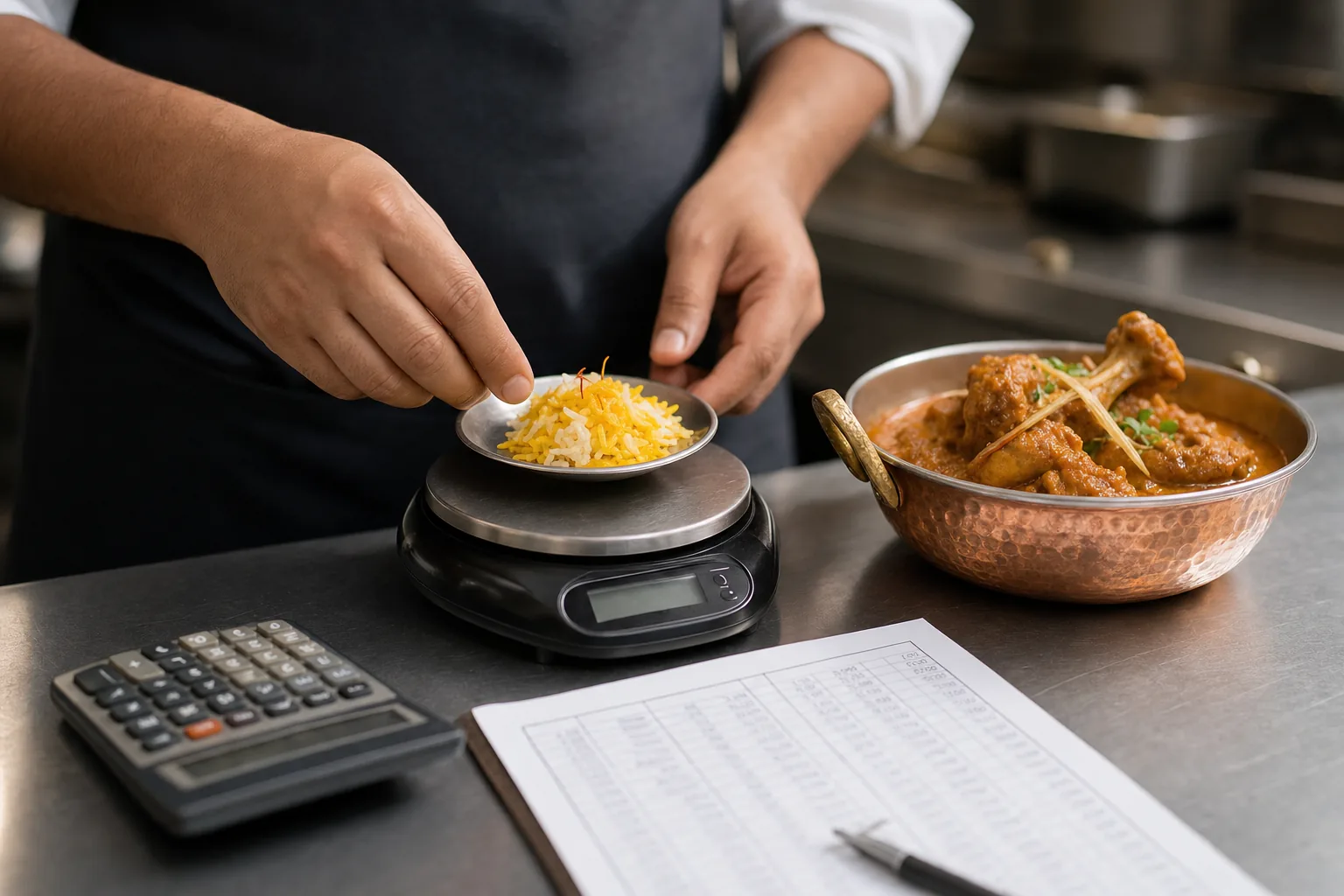
Pricing starts with knowing your costs
Every good menu price begins with an accurate plate cost. That means costing the whole dish as it leaves the pass: the protein, the sauce, the garnish, the side, the bread, the oil in the pan and the butter that finishes the sauce. Use yielded costs, because a whole chicken, a side of salmon or a crate of tomatoes loses weight to trimming, bones and spoilage before any of it reaches a plate.
Ingredient cost is only one part of the picture. Labor, rent, utilities, packaging, card fees, breakage and waste all have to be paid from what is left after food costs. A dish that looks cheap to make but needs forty minutes of skilled hand work, such as hand-rolled pasta, momos or a laminated pastry, carries a cost the recipe card does not show. Keep that in mind when two dishes have similar ingredient costs but very different prep times.
Update costs regularly. Supplier prices for dairy, oils, seafood, meat and imported ingredients can move within weeks. A quarterly costing review, plus an immediate check whenever a key ingredient jumps, keeps your prices grounded in reality rather than in last year’s invoices. Note the date and supplier price behind every plate cost, so anyone checking the sheet later can see at once which costs are stale and which dishes need repricing first.
Cost-plus pricing and food cost percentage
The most common starting point is cost-plus pricing. You choose a target food cost percentage, the share of the menu price you want ingredients to represent, and divide the plate cost by it. If a dish costs 3.20 to make and your target is 30 percent, the base price is 3.20 divided by 0.30, or 10.67. Many full-service restaurants work with targets somewhere around a quarter to a third of the price, but the right figure depends on your concept, labor model and rent.
Cost-plus is simple, consistent and protects you from pricing a dish below what it costs. Its weakness is that it ignores what guests are willing to pay. Applied mechanically, it underprices cheap-to-make dishes that guests value highly, such as a well-made dal or a pasta dish, and overprices expensive proteins that guests compare closely with other restaurants. Treat the result as a floor, not as the final answer.
- Cost the full plate using current, yielded ingredient prices.
- Choose a target food cost percentage that fits your concept and overall budget.
- Divide the plate cost by the target percentage to get a base price, net of tax.
- Add any tax that must be included in the displayed price under your local rules.
- Round to a clean price point that fits the rest of the category.
- Record the plate cost, target and final price so you can recheck it at the next review.
| Target food cost | Divide plate cost by | Base menu price |
|---|---|---|
| 25 percent | 0.25 | 12.80 |
| 28 percent | 0.28 | 11.43 |
| 30 percent | 0.30 | 10.67 |
| 33 percent | 0.33 | 9.70 |
| 35 percent | 0.35 | 9.14 |
Value-based pricing: what guests will happily pay
Value-based pricing starts from the guest’s side of the table. It asks what a dish is worth to the people ordering it, given your setting, service, reputation and the alternatives nearby. A signature dish that guests cross town for, a beautifully presented dessert or a cocktail with a theatrical serve can often carry a price well above what cost-plus would suggest, because guests are paying for the experience as much as the ingredients.
Value is not the same as charging whatever you can. Guests notice when a price feels out of line with the portion, the quality or the room, and that feeling can sour the whole visit. The aim is a price that feels fair to the guest and rewarding to the business, which usually means understanding exactly what makes a dish special and making sure the menu and the plate both communicate it.
Signals that raise perceived value
Guests judge value from many cues: a specific description of technique and ingredients, honest sourcing, generous but sensible portions, thoughtful plating and warm, knowledgeable service. A dish described as slow-cooked goat curry with bone marrow and hand-pounded spices reads very differently from mutton curry, even if the cost to make them is close. Investing in those cues often earns more than cutting a price ever would.
Read the competitive set without copying it
Look at the menus of restaurants your guests genuinely compare you with, not every restaurant in the city. Note where your prices sit for familiar benchmark dishes such as a burger, a butter chicken, a margherita or a flat white, because guests know those prices well. You do not have to match competitors, but if you charge more for a benchmark dish, the menu and the experience need to make the difference obvious.
Combine both methods, category by category
In practice, the strongest pricing uses both methods. Cost-plus tells you the lowest price you can sensibly charge. Value tells you the highest price guests will accept for that dish in your restaurant. The final price sits somewhere between the two, chosen with an eye on the rest of the category so the prices feel coherent rather than random. If the floor is above the ceiling, the dish has a problem that pricing cannot solve, and it needs a cheaper recipe, a different portion or a place off the menu.
Work one category at a time. Line up the dishes with their plate costs, cost-plus prices and your honest view of their value, then adjust. High-value, low-cost dishes can carry a richer margin. Expensive proteins may need a slightly higher food cost percentage to stay competitive, which is acceptable because they still return a large contribution margin in cash. The mix across the category matters more than any single dish hitting a target.
Once prices are set, check them against your menu engineering results over the following weeks. If a dish becomes a plowhorse after a price change, look at its margin; if a profitable dish stops selling, the price may have crossed the line from value into resistance. Listen to the floor team as well: servers hear comments about value long before they show up in the numbers, and a recurring remark about one dish is worth investigating.
Price endings, formats and currency symbols
How a price is written affects how a menu feels. Many menu designers drop the currency symbol and trailing zeros, writing 18 rather than 18.00, because the cleaner figure reads as less transactional and keeps attention on the dish. Prices ending in .99 are common in fast food and retail and can signal discount, which may not suit a full-service restaurant. Whole numbers or simple endings such as .50 usually feel calmer.
The position of the price matters as much as the format. A column of right-aligned prices connected to dish names by dotted leader lines invites guests to read down the prices and choose the cheapest option. Placing the price at the end of the description, in the same size and weight as the text, keeps the focus on the food. The price should still be clear and easy to find, because hiding it only frustrates guests.
Whatever you choose, stay consistent and follow local rules. In many places the displayed price must include taxes, and some jurisdictions require the currency to be clear. On a digital menu, consistent formatting is usually handled for you, but check that the currency and portion names are correct. Tourist areas deserve extra care, because visitors may not know whether a bare number refers to local currency, and a short note on the menu removes the doubt.
- Use the same price format on every page, including drinks and dessert cards.
- Avoid dotted leader lines and right-aligned price columns that encourage price shopping.
- Keep price endings simple and consistent with your concept.
- Make sure every portion size has its own clear price, without arithmetic for the guest.
- Show any service charge or cover charge clearly on the menu rather than surprising guests on the bill.
- Check local rules on whether displayed prices must include tax before printing.
Anchoring and the role of a premium dish
Guests judge prices by comparison. A premium dish placed near the top of a category, such as a whole grilled lobster, a tomahawk steak or a large biryani handi for sharing, sets a reference point that makes the dishes around it feel more reasonable. This is known as anchoring. The premium dish does not need to be a bestseller to do its job, although it should be genuinely good and profitable when it is ordered.
Anchoring works best when it is honest. The premium dish should offer real extra value, such as a larger portion, a rarer ingredient or a dish built for sharing, rather than existing only to make other prices look smaller. Guests who order it should feel the price was justified, because an anchor that disappoints damages trust in the whole menu.
Within a category, a sensible spread of prices also helps. If every main sits within a narrow band, guests choose purely by preference; if one dish is far more expensive than the rest, it can look out of place. A gradual spread, with a clear reason for each step up, lets guests trade up comfortably when they want to. The same thinking applies to drinks, where a premium pour or a reserve wine by the glass makes the house options feel like sensible choices.
Guests who order it should feel the price was justified, because an anchor that disappoints damages trust in the whole menu.
Portion sizes and offering more than one size
Portion size is part of the price. A plate that looks sparse for its price feels expensive even when the margin is modest, while an oversized portion can quietly destroy margin and increase waste. Set a portion specification for every dish, in grams or pieces, and give cooks the tools to hit it: scales, portion scoops, ladles of known volume and a photo of the correct plate at each station.
Offering more than one size can widen a dish’s appeal. Half and full portions of a biryani, small and large plates of a pasta, a single or double espresso, or a glass and a carafe of wine let guests choose by appetite and budget. Price the sizes so that the larger one offers a little more value per gram while still returning a stronger total margin, and make sure both sizes are worth ordering.
Keep the number of sizes manageable, usually two and occasionally three, so the menu stays easy to read. If you run a digital menu, Menulo lets you list each priced portion under the same dish, such as half and full, and mark a single portion sold out when the kitchen runs short of it. Name sizes in words guests understand, such as half and full or small and large, rather than internal codes, and check each size against its portion specification during service.
How to raise prices without losing guests
Price increases are a normal part of running a restaurant, especially when ingredient, energy and labor costs rise. The goal is to raise prices in a way that guests barely notice or readily accept. Small, regular adjustments are usually received better than a single dramatic jump, and targeted changes on dishes with the most room work better than a flat percentage across the whole menu.
Start with the dishes that can carry an increase most easily, such as stars that guests value highly, premium items and dishes where your price sits below the competitive set. Be cautious with benchmark dishes guests know well and with plowhorses that keep the room busy. Where a straight increase would feel too large, look at the plate instead: a smarter garnish, a different side or a reworked recipe can protect margin without changing the price.
- Re-cost every dish with current supplier prices to see where margins have slipped most.
- Identify dishes with room to move, starting with stars and premium items rather than benchmark dishes.
- Plan small increases spread over several months rather than one large jump.
- Improve the description or presentation of dishes whose price is rising, so the value is visible.
- Brief the team on what changed and why, so they can answer guest questions calmly.
- Update every menu, digital and printed, on the same day so guests never see conflicting prices.
- Track item sales from your POS or sales records over the following weeks and adjust if a dish stalls.
Taxes, service charges and price transparency
Clear pricing is part of hospitality. Guests should know what they will pay before they order, including any service charge, cover charge or tax that will be added. Rules differ widely by country and region: some places require displayed prices to include tax, others regulate how service charges are presented or whether they can be added at all. Check the current rules where you operate, and when in doubt, show the full price.
Keep every version of the menu in sync. A price that differs between the printed menu, the digital menu and the bill creates awkward conversations and can breach consumer protection rules. When you change prices, update all menus together, and remove old printed copies from circulation rather than letting them linger at the host stand. Delivery listings, table tents and specials boards count too; a forgotten chalkboard showing last month’s price is a common source of disputes.
Finally, review pricing on a schedule rather than only in a crisis. A quarterly review of plate costs, category margins and guest feedback keeps prices fair and current, and it means increases arrive as small, considered steps instead of sudden shocks. Put the review in the calendar alongside the menu engineering analysis, because the two answer different halves of the same question: what each dish costs, and what each dish earns once guests have made their choices.
Frequently asked questions
How do you calculate menu prices?
Start by costing the full plate with current, yielded ingredient prices. Divide that plate cost by your target food cost percentage to get a cost-plus base price; for example, a 3.20 plate cost at a 30 percent target gives 10.67. Then adjust for perceived value, competitor benchmarks and the rest of the category, and round to a clean price point.
What is a good food cost percentage for a restaurant?
There is no universal number. Many full-service restaurants work with targets around a quarter to a third of the menu price, but the right figure depends on your concept, labor costs, rent and service style. Judge it across the whole category or menu using item sales from your POS or sales records, because individual dishes will naturally run above or below the target.
Should menu prices include the currency symbol?
Many menu designers leave out the currency symbol and trailing zeros, writing 18 rather than 18.00, because the cleaner format keeps attention on the food. Whatever you choose, the price must still be clear, the currency must be obvious where guests might be unsure, and you should follow any local rules on how prices and taxes are displayed.
How often should restaurants raise prices?
Review prices at least once a quarter alongside your plate costs, and act sooner if a key ingredient jumps sharply. Small, targeted increases spread over time are usually received better than one large rise across the whole menu. Start with dishes that have the most room, such as stars and premium items, and track sales afterward to catch any dish that stalls.
Is it better to reduce portion sizes or raise prices?
It depends on the dish. Guests notice smaller portions quickly, especially on favorites, so cutting a portion can feel worse than a modest price increase. Often the best option is to rework the plate, changing a garnish or side or rebalancing components, while protecting the part guests value. Offering a smaller size at a lower price alongside the original can also work well.
- #menupricing
- #foodcostpercentage
- #restaurantpricingstrategy
- #priceincreases
- #portionsizes